Writing to Preserve Memories and Pass on a Legacy
Firefly LaneWriting to Preserve Memories and Pass on a Legacy is the practice of turning lived experience into a record that can outlast separation and death. In the novel, its meaning changes as its keepers grow older: Tully Hart first writes toward an absent mother, while Kate Ryan eventually writes for her children and gives Tully the finished account of a friendship that has shaped both their lives. Scrapbooks, letters, and a leather-bound journal make memory tangible, but the records matter most for what they preserve beyond dates and artifacts: a person’s own understanding of love, regret, and who she has been.
Early Forms: A Scrapbook and Letters
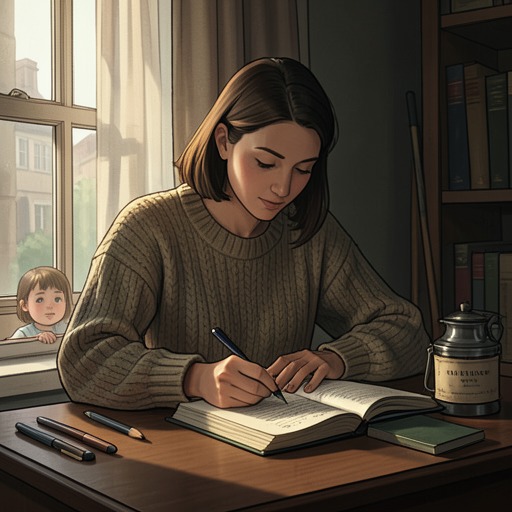
At eleven, Tully receives a new scrapbook and imagines giving it to her mother one day, as proof of the life her mother has missed. The blank first page exposes the difficulty behind that hope: Tully has few photographs of herself, only one picture of her mother, and no obvious way to assemble the life she wants to show. She writes the date in the corner and begins with an address to her mother, turning an empty album into an appeal across absence.
The scrapbook soon becomes an accumulating record. Tully saves school and sports photographs, movie-ticket stubs, and other small artifacts; after a good day, she writes about it and pastes in a receipt or ticket as evidence of where she has been. The objects anchor her account in particular experiences, while the writing supplies the recognition she wants from her mother. Tully admits that she sometimes embellishes her stories to make herself look better, hoping that one day her mother will be proud of her. The record is therefore not a neutral archive: it is both a collection of remembered life and an imagined message to the person whose approval Tully longs for. She fills one scrapbook after another, receiving a new one for each birthday until she reaches her teenage years.
Letters later offer Tully a more immediate audience. For three years, she and Kate write faithfully to each other; their correspondence becomes both tradition and lifeline. Every Sunday evening, Tully sits at the white desk in her lavender-and-pink room and puts her thoughts, dreams, worries, and frustrations on notebook paper. Some letters cover ordinary details, including a Farrah Fawcett haircut or a Gunny Sax dress for junior prom; others disclose sleeplessness and the recurring dream that her mother will return and say she is proud of her. When Tully’s grandfather dies, Kate’s letter of sympathy reaches a grief Tully had not been able to express before hearing from her friend. In writing to Kate, Tully largely stops embellishing and lets herself be known as she is. The correspondence becomes valuable not just because it preserves events, but because it creates a relationship in which the truth can be received.
Memory Kept Between Friends
The novel repeatedly locates shared memory in physical and cultural markers. Songs associated with Tully and Kate—including “Goodbye Yellow Brick Road,” “Material Girl,” “Bohemian Rhapsody,” “Purple Rain,” and “You’ve Got a Friend”—can return Tully to their friendship with enough force to make a bad version of “You’ve Got a Friend” bring her to tears beside the radishes in a grocery store. Their past is not held only in a written archive: music carries it into the present, unexpectedly and bodily.
Time itself also becomes legible through recurring markers. Kate remembers the cherry trees in the University of Washington Quad as signs of seasons passing during college, and later measures years by the “SEASON’S GREETINGS” flag beneath streetlamps near the Public Market. In the 1990s, Tully’s changing television hairstyles become another seasonal calendar for Kate, who watches the morning show while caring for Marah. These details show how one person’s public image and the ordinary landscape around another can become a private system of remembrance. The changing styles and years do not erase the friendship; they give Kate a way to locate it in the flow of her own life.
A dream returns Kate to 1974, when she and Tully ride their bicycles together at midnight along the country road that will be known as Firefly Lane. In the dream, the road’s meaning is inseparable from their meeting: before they saw it through each other’s eyes, it seemed to go nowhere. As Kate grows less able to distance herself from her memories, the place comes back with particular vividness. Firefly Lane thus works both as a real setting in their shared past and as a compressed image of the friendship through which an otherwise ordinary road acquired significance.
Kate’s Journal: A Record for Her Children
When Tully gives Kate a hand-tooled, leather-bound journal, its first page bears the title “Katie’s story.” Kate initially resists the project: she says she was never really a writer and believes it is too late to become one. Tully redirects the purpose of the book away from a belated career and toward Kate’s children. Marah and the boys, she explains, will someday be old enough to read it and will want to know who their mother was. When Kate asks how to begin, Tully has no formula; she tells her simply to write what she remembers.
The journal’s material form emphasizes the weight of that invitation. Kate traces the leather etchings and gold-edged pages before taking up her pen. She knows that writing will make her revisit both the person she was and the person she wanted to be, and that good and bad memories alike will hurt. Yet she understands that her children may otherwise see the illness more clearly than the woman they will always remember but have too little time to know. The book gives them a way to encounter her in her own words, rather than only through the experience of her sickness or other people’s recollections.
Kate begins without a settled plan, writing first about panic: its familiar knot in her stomach, nausea, and breathlessness, and the changing circumstances that trigger fear. Her account connects her present illness to family life. She notices Johnny’s sadness as he draws away after a kiss and Marah’s quiet acceptance of what she says; she wishes she could have another of the arguments through which Marah once struggled to become herself and Kate struggled to let her go. Looking back, Kate recognizes those fights as part of their love and regrets not understanding their meaning at the time. She also tells Marah that both of them regret things they said, but that none of it changes her love. The journal preserves not an idealized family story but a mother’s revised understanding of its conflicts.
As the journal nears completion, Kate’s sense of what a life story should contain shifts. She began, she writes, with the expectation that she would record dates, times, names, successes, failures, and the timeline of youth and middle age. What remains most clearly to her, instead, is “Love. Family. Laughter.” She writes that she wants her children to know how proud she is of them and of herself, and that she and Johnny and the children were everything they needed. The conclusion does not deny the lives’ chronology; it identifies the emotional knowledge that chronology alone could not convey.
Passing the Story On
Kate gives the journal to Tully, who has watched her write through the summer, at first quickly and later with increasing slowness. The gift moves the record beyond its original purpose. Kate began it so her children could know their mother, but Tully, who has spent a lifetime sharing the experiences being written down, becomes its first reader. Unable to speak through the lump in her throat, she takes Kate’s hand and opens to the first page. Its opening line recalls the first time Kate saw Tully, making the friend herself the beginning of Kate’s life story. Tully laughs and continues reading, encountering their shared past as Kate has chosen to tell it.
The exchange completes a movement begun with Tully’s childhood scrapbooks. As a girl, she collected evidence in the hope that her absent mother might someday recognize the life she had missed; as an adult, she receives a record made by a friend who knows her history from within. Kate’s journal answers the problem that Tully’s first album could not solve: how a record can do more than display proof that a life happened. It can preserve a voice and give another person the means to remember its meaning.
Kate’s final letter to Tully extends that work beyond the journal and beyond Kate’s lifetime. Written in Kate’s unmistakable hand and placed atop a box given to Tully, it asks her to care for Johnny and the children, to teach the boys to be gentlemen and Marah to be strong, and to give them the journal when they are ready. Kate wants them to know the truth about her. She also anticipates Tully’s belief that Kate has left her, rejects that interpretation, and points her back to the memory of Firefly Lane and the enduring idea of “TullyandKate.” The letter does not erase the loss. It leaves Tully with specific responsibilities and a shared name through which their friendship can continue to be remembered.
Across these forms, the meaning of writing changes from pleading for recognition to preserving a life for those who remain. Tully’s scrapbooks record days in the hope of being seen; her letters let her speak more honestly to Kate; Kate’s journal turns remembered experience into a legacy for her children and a gift to her closest friend. The novel’s final emphasis is not on the completeness of any archive, but on the relationships that make its fragments matter: people preserve the past for one another, and what they choose to remember can carry love beyond the time they have together.